Developer & Technical Docs — Seeded Post #3: Smart Contract Deploy Guide (OBP-1)
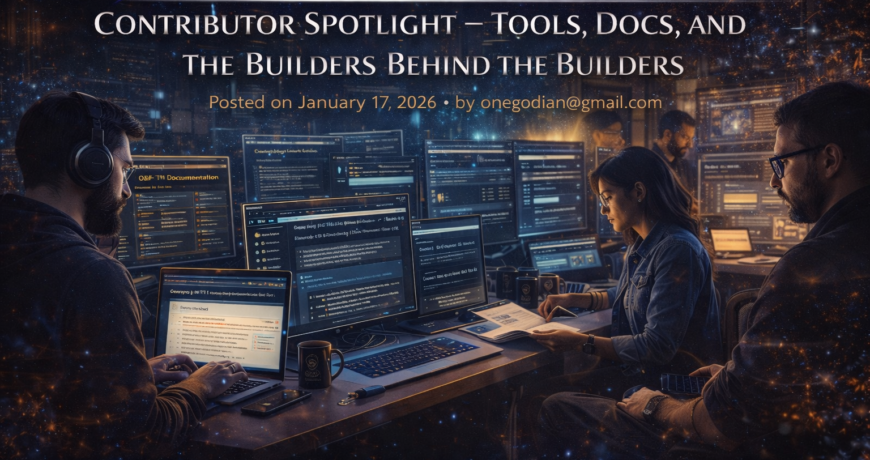
Contributor Spotlight — Tools, Docs, and the Builders Behind the Builders
Posted on: January 17, 2026
Posted by: onegodian@gmail.com
Category: Community & Stories
The Work You Don’t See Is the Work That Holds Everything Together
Every system that lasts has two kinds of builders:
- Those who create the core
- Those who make the core usable, understandable, and repeatable
This post honors the second group.
Welcome to Contributor Spotlight #3, recognizing the people behind the tools, documentation, and developer experience that make OBP-1™ more than an idea—and turn it into a living, buildable system.
Why Tools and Docs Are Sovereign Infrastructure
In most tech ecosystems, documentation is an afterthought.
In OBP-1™, documentation is part of the protocol.
Why?
Because sovereignty fails when:
- Knowledge is trapped in a few heads
- Systems can’t be reproduced
- Builders depend on oral tradition or private access
OBP-1™ rejects that model.
If a system cannot be:
- Explained clearly
- Used correctly by others
- Audited without permission
…it does not qualify as sovereign infrastructure.
What the “Builders Behind the Builders” Do
This contributor group focuses on enablement, not visibility.
Their work includes:
🧠 Documentation & Canon
- Developer guides and onboarding flows
- Clear explanations of OBP-1™ concepts (scrolls, registries, verification)
- Canon alignment checks to prevent drift or contradiction
- Versioned documentation that matches deployed systems
Their goal: no mystery layers.
🛠️ Tooling & Interfaces
- ODIN code generators
- Registry ID testing tools
- Verification demos and simulators
- HTML widgets and UI scaffolding
- Testnet helpers and mock data tools
Their goal: reduce friction without reducing integrity.
🧾 Developer Experience (DX)
- Clean, readable examples
- Deterministic outputs (no “magic”)
- Predictable structures that don’t surprise builders
- Interfaces that teach while they work
Their goal: make the right thing the easy thing.
How OBP-1™ Approaches Tooling Differently
1. Tools Are Educational by Design
Every tool should answer:
“What is happening, and why?”
If a tool hides logic, it creates dependency.
OBP-1™ tools surface logic to create capability.
2. Docs Are Canon, Not Commentary
Documentation is not marketing copy.
It is:
- Structured
- Versioned
- Referenced by ODIN codes where applicable
- Aligned with law, not hype
If the docs disagree with the system, the system is wrong—or incomplete.
3. Builders Are Stewards
The people writing docs and tools are not “support staff.”
They are stewards of clarity.
Their responsibility is to ensure OBP-1™:
- Can be built on without permission
- Can be understood without indoctrination
- Can be extended without breaking its core truths
What This Enables
Because of this work, OBP-1™ can:
- Onboard new developers without gatekeepers
- Explain itself to regulators, researchers, and communities
- Support long-term continuity beyond any one team
- Resist capture through obscurity or complexity
This is how systems outlive their creators.
A Note to Future Contributors
If you:
- Enjoy making complex things clear
- Care about naming, structure, and correctness
- Believe documentation is an act of respect
There is a place for you here.
You don’t need to write code every day to build sovereignty.
Sometimes the most important contribution is making sure others can build correctly.
Closing
Contributor Spotlight #3 is for those whose names may not appear in commit histories—but whose work appears everywhere else.
In every clean interface.
In every understandable guide.
In every developer who didn’t get stuck.
OBP-1™ stands because clarity was treated as infrastructure.
Next in Community & Stories:
Contributor Spotlight #4 — Testing, Validation, and the Guardians of Correctness
OBP-1™ is live. Sovereignty is verified. And it’s being built—clearly, carefully, and together.